
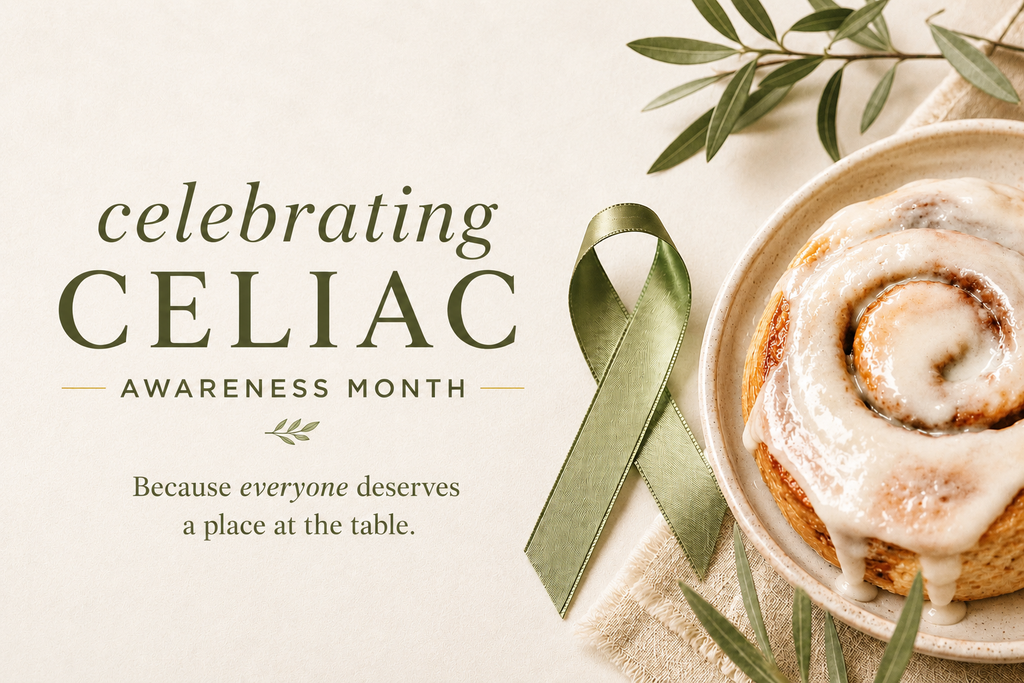
Celiac disease changes more than what you eat—it changes the way you move through everyday life.
For many people, the diagnosis doesn’t come with clarity right away. It comes with questions.
- What can I eat now?
- What do I have to give up?
- How do I navigate restaurants, family gatherings, baking, travel—all the normal parts of life that suddenly feel complicated?
If you’re in that place right now, you’re not alone.
The early days can feel overwhelming
When I was first diagnosed with celiac disease, I didn’t immediately understand what it would mean long-term. I just knew everything felt different.
Food—something that had always felt simple—suddenly required thought, planning, and caution. Even familiar routines like grabbing a quick snack or going out to eat felt uncertain.
There’s a learning curve that comes with celiac disease, and it’s not just about ingredients. It’s about rebuilding confidence in something you used to do without thinking.
And that can take time.
What I wish I knew sooner
Looking back, there are a few things I wish someone had told me earlier:
You don’t have to figure everything out at once.
You will learn what works for you over time.
And it’s okay if it feels like a lot in the beginning.
Some of the most helpful shifts didn’t happen overnight—they came from small adjustments and steady learning:
-
Finding a few reliable meals and recipes to lean on
-
Learning how to read labels more confidently
-
Asking more questions when eating out
-
Giving myself permission to not be perfect at it right away
Celiac disease becomes more manageable as you build familiarity. It stops feeling like constant uncertainty and starts becoming a rhythm you understand.
Finding your way in the kitchen again
One of the hardest parts for many people is baking.
So much of traditional baking is built around ingredients that suddenly feel off-limits, and early gluten-free options don’t always feel satisfying or familiar.
But baking doesn’t have to disappear—it just changes shape.
Over time, I learned that gluten-free baking can still feel comforting, simple, and enjoyable. It just takes the right approach and the right support.
If you’re looking for guidance, I’ve shared more practical resources here:
Where MinusG fits in
MinusG started from that same place of frustration and adjustment—trying to make baking taste good again without compromise.
Our mixes were created to take some of the uncertainty out of gluten-free baking, so you can spend less time worrying about what might go wrong and more time enjoying what comes out of the oven.
A note for anyone newly diagnosed
If you’re just starting this journey, I want to leave you with this:
It won’t always feel this overwhelming.
Right now, you’re learning a new way of living—and that takes time, patience, and a lot of small adjustments. But it does get easier. You will find your rhythm again. And food becomes something you can enjoy again, not something you have to fear.
You don’t have to go through it alone, either.
If you ever have questions or just need encouragement from someone who’s been through it, I’m always happy to share what I’ve learned along the way. You can find me on instagram and facebook.
~Katherine, the MinusG Baker
If you want to read more of the story
If this resonated with you, you may also find this helpful: